
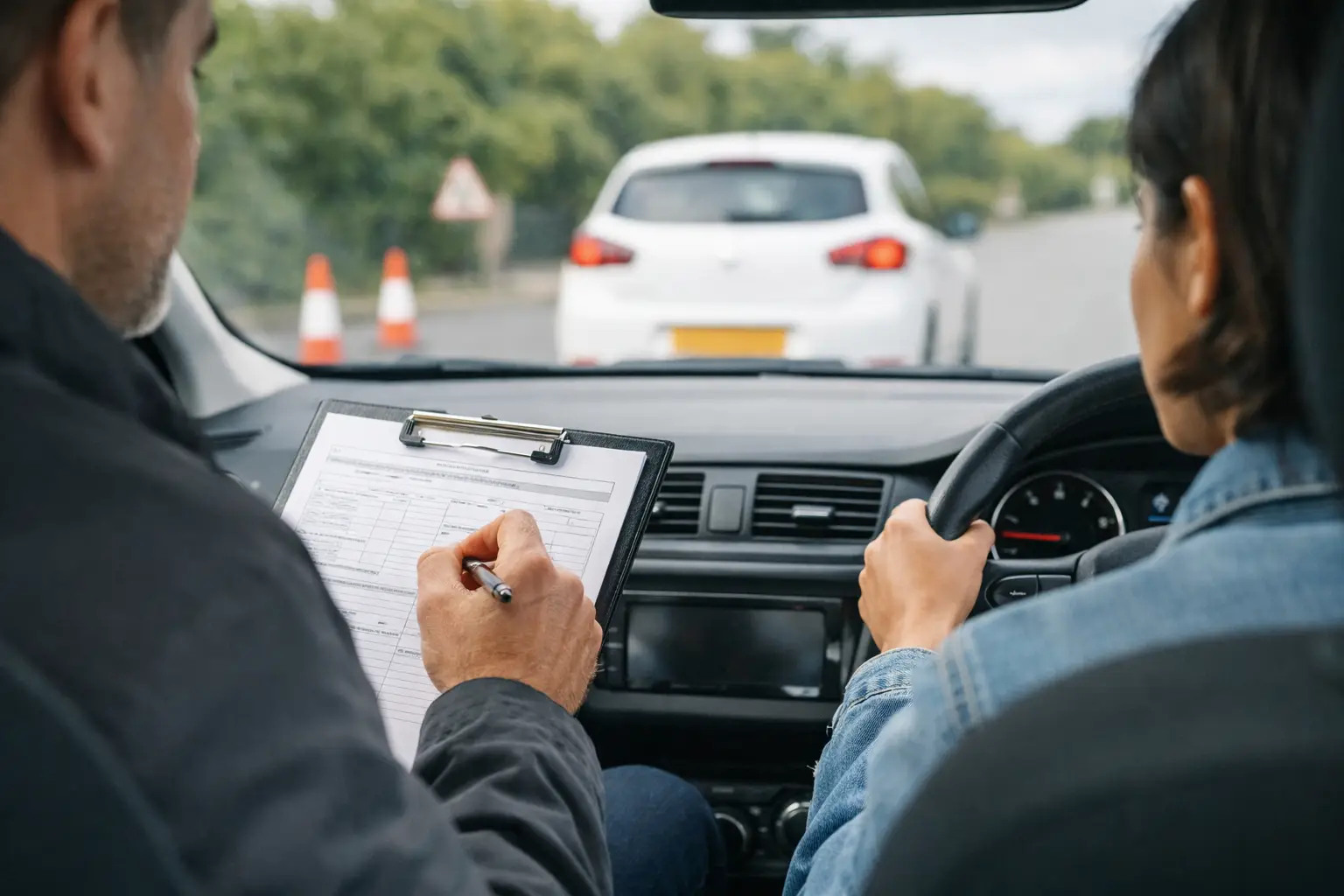
That moment when the examiner starts writing on the tablet can feel oddly dramatic. One quick tap and your brain decides you have either clipped a kerb, forgotten every mirror check you've ever done, or somehow offended a roundabout. A good guide to DVSA driving test marking helps cut through that panic, because the marking system is more structured than many learners realise.
If you understand how faults are assessed, the test becomes less mysterious. You are not expected to drive like a chauffeur for the King. You are expected to drive safely, legally and with good awareness. That is a much more achievable standard, and knowing where the marks come from can make your preparation far more focused.
What the DVSA is actually marking
The driving test is not about catching you out with sneaky tricks. The examiner is looking at whether you can drive independently without putting yourself or others at risk. That means your result is based on decisions, observations, control and how you respond to real road conditions.
You can make small mistakes and still pass. That surprises a lot of people. The test is not scored like a school exam where every error drags your grade down. Instead, faults are grouped by seriousness. The key question is not whether you were perfect, but whether your driving stayed safe.
A guide to DVSA driving test marking categories
DVSA driving test marking uses three main fault categories. Once you understand these, the whole process becomes much easier to read.
Driving faults
A driving fault is often called a minor fault. This is something that is not quite right, but not dangerous in itself. Think of hesitating a bit too long at a junction, selecting the wrong gear and then correcting it, or missing a mirror check when the situation is otherwise quiet and unaffected.
One or two minor faults in different areas will not usually stop you passing. Even more than that can still result in a pass, depending on the pattern. Where learners get caught out is when the same minor fault keeps happening. If you repeatedly make the same mistake, it can show a weakness in skill or awareness rather than a one-off slip.
Serious faults
A serious fault means the mistake had the potential to be dangerous. Maybe you emerged at a junction when it was not properly safe, missed a key observation, or made another road user change speed or direction because of what you did. That is an instant fail.
This is where context matters. The same basic mistake can be minor in one situation and serious in another. Forgetting a mirror on an empty road is not viewed the same way as forgetting it before moving across traffic.
Dangerous faults
A dangerous fault is where there is actual danger to you, the examiner, the public or property. If your action creates immediate risk, the test ends as a fail. Examples might include driving through a red light, pulling out directly into another vehicle's path, or losing control of the car.
It sounds harsh, but it is fair. The test is there to check whether you are safe to drive alone. If a fault creates genuine danger, the result has to reflect that.
Why repeated minor faults matter
This is one of the biggest misunderstandings in any guide to DVSA driving test marking. Learners often hear that you can have up to 15 minors and still pass, which is technically true, but it misses the point.
If you collect several driving faults for the same issue, the examiner may decide that the repeated problem is serious. For example, if you forget effective mirror use over and over again, that is no longer a harmless blip. It suggests your observation habits are not reliable.
So yes, the total number matters, but the pattern matters just as much. A scattered handful of small mistakes is very different from a clear ongoing weakness.
The test report sheet and what it covers
At the end of the test, the examiner records faults across set areas of driving. These include things like moving off safely, use of mirrors, control, judgement, positioning, response to signs and signals, and progress.
That last one catches people out. Progress does not mean speeding up to impress anyone. It means making reasonable progress when it is safe to do so. Driving far too slowly, hesitating excessively, or waiting through obvious safe gaps can be marked because it affects traffic flow and shows uncertainty.
The examiner is building a picture of your overall driving. They are not looking for one perfect manoeuvre or one polished roundabout. They are looking for consistent, safe behaviour from start to finish.
What causes a fail most often
Most failed tests are not lost on the reverse bay park. They are usually lost on the everyday basics. Observation is a huge one. Missing mirrors, poor blind spot checks and weak junction observations cause trouble because they link directly to safety.
Junctions themselves are another common area. Learners may approach too fast, stop when they could have gone, or go when they should have waited. Roundabouts bring the same challenge with extra pressure added.
Then there is positioning. Drifting too close to parked cars, turning right from the wrong place, or lane discipline problems on larger roundabouts can quickly move from untidy to serious. The awkward truth is that boring basics win tests. Glamorous they are not, but they do the job.
How manoeuvres and independent driving are marked
The reversing exercise is only one part of the test, and a small mistake during it does not automatically mean failure. If your parking is a little untidy but corrected safely and under control, that may be a driving fault rather than a serious one.
What matters more is observation and control. If you reverse without checking around properly, or you rely on luck rather than awareness, that becomes much more serious.
Independent driving is marked in exactly the same way as the rest of the test. Following sat nav directions or traffic signs is not a separate exam within the exam. If you go the wrong way, that is not automatically a fault. Safe driving matters more than perfect navigation. If you take a wrong turn calmly and legally, the examiner will simply redirect you.
The role of nerves in DVSA driving test marking
Nerves are normal. Nearly everyone has them, even people who look suspiciously calm in the waiting room. The examiner knows this. A brief wobble does not mean they are sharpening the fail stamp.
What matters is how nerves affect your driving. If you stall and recover safely, that may not be a big issue. If nerves make you stop observing properly, rush decisions or forget routines, then faults start appearing.
This is why test preparation should not just focus on route practice. It should focus on routines that hold up under pressure. Good mirror habits, clear junction routines and steady clutch control are your safety net when your brain temporarily goes on holiday.
How to prepare with the marking system in mind
The smartest way to prepare is to stop chasing perfection and start chasing consistency. Ask your instructor where your faults are repeating, because repeated patterns are far more important than the occasional slip.
If mirror checks are patchy, work on that until they become automatic. If roundabouts cause hesitation, practise reading gaps and committing when it is safe. If you drive well in lessons but unravel under pressure, build in mock tests so the format feels familiar rather than intimidating.
At D4Driving School of Motoring, this is exactly why personalised test preparation matters. Two learners can both be "nearly ready" and still need completely different final coaching. One may need polish on manoeuvres. Another may need stronger decision-making at busy junctions. Tailored lessons make much more sense than repeating the same generic route and hoping for magic.
What a pass-ready drive really looks like
A pass-ready drive is calm, safe and sensible. It is not flashy. You do not need to narrate the Highway Code from memory or glide around like you are filming a car advert.
You need to show that you can manage normal roads with normal hazards in a responsible way. That means useful observations, correct signals, sensible speed, steady control and good judgement. Small imperfections can exist within that. Unsafe habits cannot.
There is also an "it depends" element to nearly every fault. A slow approach to a junction may be cautious in one setting and hesitant in another. A missed mirror check might be low-level on a quiet road and serious in heavier traffic. That is why experienced instruction matters - not just learning what the rules are, but learning how they apply in real situations.
The best thing you can do before test day is stop treating the examiner's marking as a mystery. It is simply a structured way of asking one question: would this person be safe driving on their own? If you prepare around that standard, rather than chasing a mythical perfect drive, the whole test starts to feel far more manageable. And that is usually when better driving shows up.