
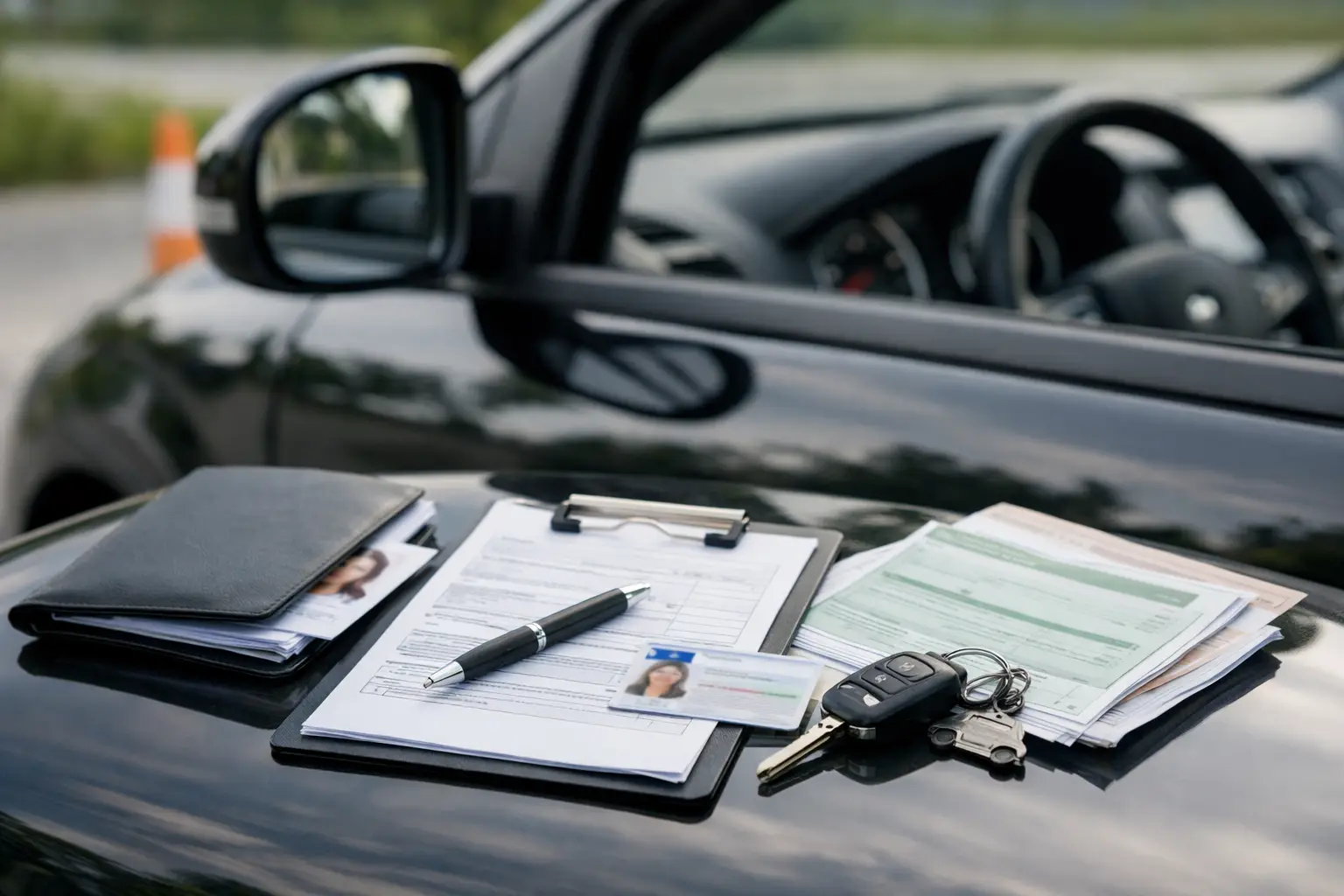
The last thing a learner needs on test day is a preventable problem at the test centre. You have spent weeks practising roundabouts, manoeuvres and independent driving. Do not let five essential driving test documents, or a missing vehicle check, create extra nerves before you have even turned the key.
There is one useful truth to remember: not every candidate must arrive carrying a folder full of paperwork. If you are taking your test in your instructor’s car, much of the vehicle administration is handled for you. If you are using your own car, a parent’s car or a borrowed vehicle, your checks need to be more thorough.
The five essential driving test documents to check
1. Your valid provisional driving licence
Your provisional driving licence is the one document you cannot do without. The name, date of birth and driving licence number need to match the details used when you booked your practical test. Check this well before the appointment, especially if you have changed your name, moved house or replaced a lost licence recently.
Bring the photocard licence with you. Keep it somewhere safe the night before, rather than relying on a frantic bedroom search while someone outside is saying, “We really should leave now.” Test-day nerves are quite enough without playing hide-and-seek with a wallet.
If you do not have a valid provisional licence, you cannot take the test. A screenshot, an expired card or a promise that it is definitely somewhere at home will not solve the problem at the test centre.
2. Your practical test booking confirmation
You do not normally have to print and hand over your booking confirmation, but having the email or text confirmation available is sensible. It confirms the date, time, test centre and reference number, which is particularly helpful if there is a query about your appointment.
Save the confirmation on your phone and make a note of the booking reference separately. Phones run out of battery at impressively inconvenient moments. A printed copy is optional, but it can be a reassuring backup if you prefer to have everything organised.
Check the test centre carefully too. Peterborough, Kettering and Grantham test preparation candidates can be travelling to a centre they do not use every week. Allow time for traffic, parking and finding the correct meeting point. Arriving early gives you a chance to settle, use the toilet and take a breath. Arriving late may mean losing the test altogether.
3. Your theory test pass details
You must have passed the theory test before you can book a practical driving test. In most cases, the examiner can confirm your pass electronically, so you are not usually required to show a paper theory pass certificate on the day.
Still, keep the pass details or certificate in your records. It is useful when checking your booking, resolving an administrative issue or confirming that your theory pass is still valid. A theory test pass lasts for two years. If it expires before you pass the practical test, you will need to take and pass the theory test again.
This is a good reason not to leave practical test preparation until the final few weeks. A calm, structured approach gives you time to build safe habits rather than trying to cram confidence into a handful of lessons.
4. Proof that the test car is insured
If you are taking the test in your instructor’s car, ask in advance whether insurance and vehicle requirements are covered. A professional instructor will normally have this in hand, allowing you to focus on driving safely and independently.
If you are using your own car or a borrowed one, make sure the insurance policy covers you for the practical driving test. Do not assume that being insured for practice automatically means you are covered for the test. Policies differ, and some have restrictions relating to age, named drivers or tests.
You may not be asked to produce a printed insurance certificate, but you should be able to show that suitable cover is in place if needed. Keep the policy details accessible on your phone or have a paper copy available. It is a small check that protects a very important appointment.
5. The car’s MOT information, where applicable
A car used for a practical test must be roadworthy. For vehicles more than three years old, that includes having a valid MOT. You do not usually need to carry the physical MOT certificate, as the status can be checked electronically, but you should verify the expiry date before test day.
An MOT alone does not make a car suitable for the test. Check that the tyres are legal and correctly inflated, the lights work, the windscreen is clean, the mirrors are secure and there is enough fuel. The car must also display L plates on the front and rear. If it has a serious warning light showing, visible damage that affects safety or a fault that makes it unsuitable, the examiner may refuse to conduct the test.
When you are using your instructor’s car
Taking the test in an instructor’s car can remove several practical worries. The car should be dual-controlled, insured for lessons and tests, maintained properly and fitted with the required L plates. You still need your provisional licence and appointment details, but you are not responsible for locating insurance documents or checking when the MOT runs out.
That does not mean you should treat the car as a surprise on the day. Practise in it beforehand, including the controls, mirrors, clutch bite if it is manual, and the way it feels on hill starts and slower manoeuvres. Familiarity leaves more mental space for observation, planning and making sensible decisions.
At D4Driving School of Motoring, focused test preparation is built around those final details as well as the driving itself. A lesson before the test should help you feel settled and ready, not overloaded with last-minute instructions.
Do not confuse documents with vehicle suitability
Learners sometimes focus so hard on paperwork that they overlook the car itself. A test car needs an extra interior mirror for the examiner and must meet DVSA requirements. Certain vehicles are not allowed for the practical test, including some cars with restricted visibility or unsuitable seating arrangements.
If you are using a privately owned car, check its suitability well before the booking date. Do not wait until the morning of the test to discover that a warning light has appeared, a tyre is damaged or the car cannot be used. It depends on the vehicle, so when in doubt, ask your instructor for an honest opinion early enough to arrange an alternative.
Manual and automatic candidates should also check they are booked for the right type of test. Passing in an automatic car gives you an automatic-only licence. Passing in a manual car allows you to drive both manual and automatic vehicles. Neither route is inherently better - the right choice is the one that helps you drive safely, confidently and consistently.
A simple check the day before your test
The day before, place your provisional licence, booking reference and any relevant vehicle information together. Charge your phone, check the test time and set off plans, then give yourself permission to stop revising every possible mistake.
Use the final drive as a confidence-builder, not a judgement. You do not need perfect driving. You need safe, legal driving with good observation, appropriate speed and the ability to respond calmly when something does not go exactly to plan.
Test day is not about producing a flawless performance for an examiner. It is your opportunity to show the safe, thoughtful driving you have been building lesson by lesson - and having the right details ready lets that work speak for itself.