
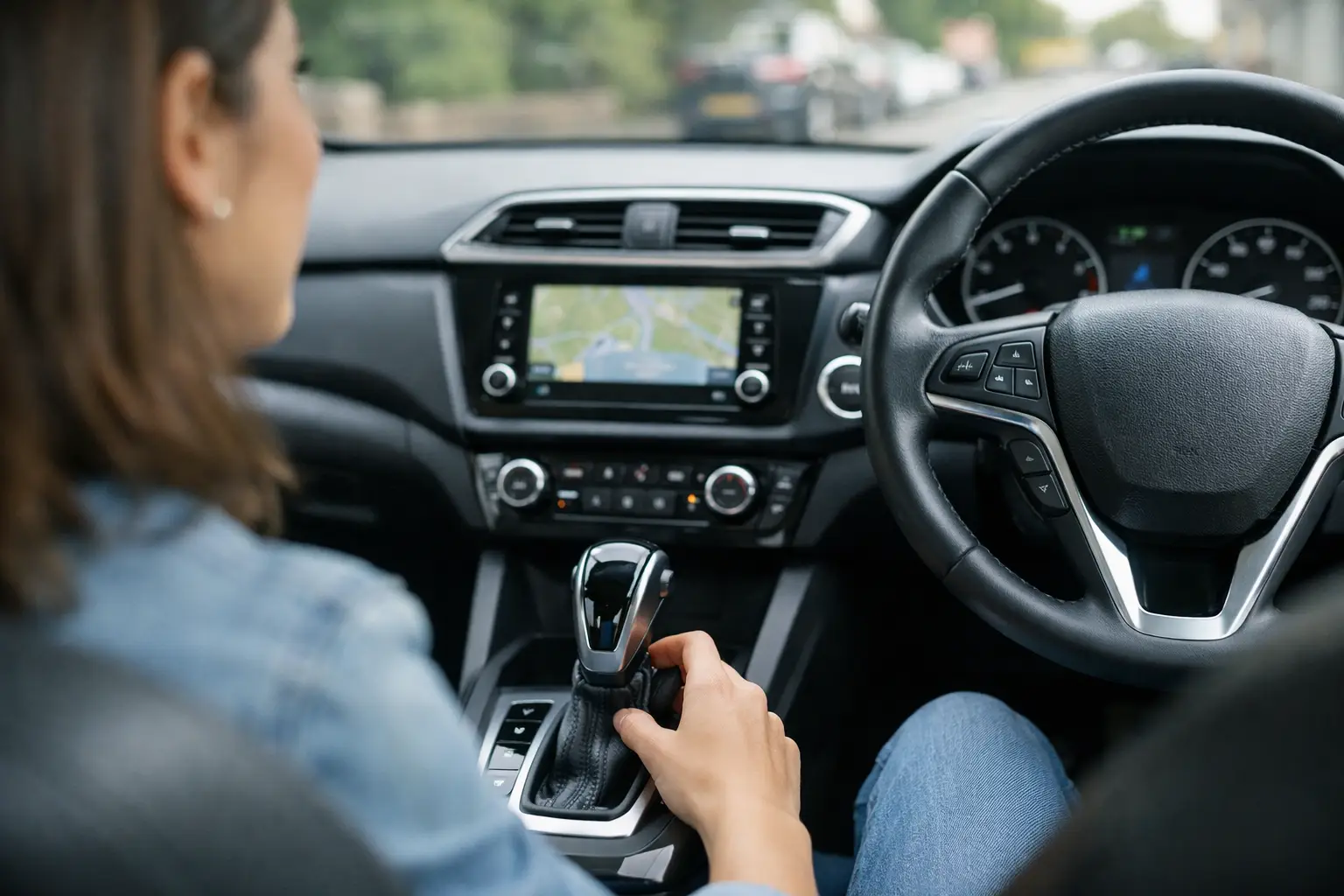
The first time you sit in an automatic car, the pedals may look reassuringly simple. There are only two of them, after all. Yet the gear selector, dashboard symbols and steering-wheel buttons can still make the driver’s seat feel like mission control. This guide to automatic car controls for learners breaks each one down clearly, so your early lessons feel calm, safe and far less mysterious.
An automatic takes away the clutch and gear-changing routine, but it does not take away the need for good observation, accurate steering and thoughtful decisions. The aim is not to memorise every button before your first drive. It is to know the controls you will use most, understand why they matter and build confidence one step at a time.
Start with the driving position
Before touching the gear selector, set yourself up properly. Adjust your seat so you can press the brake pedal firmly while keeping a slight bend in your knee. Your back should be supported, and you should be able to hold the steering wheel comfortably without stretching.
Set the head restraint so its solid centre sits roughly level with the back of your head. Then adjust the interior mirror and door mirrors to give you a clear view behind and along the sides of the car. A good driving position is not just about comfort. It helps you react quickly, steer smoothly and see developing hazards earlier.
Most automatic cars will only start when the selector is in Park and your foot is firmly on the brake. Keep your right foot ready for both pedals. Your left foot has a well-earned rest in an automatic - keep it on the footrest rather than hovering near the pedals. Using both feet can lead to accidental braking, which is uncomfortable for everyone and particularly unfair on any loose coffee in the cup holder.
The pedals: brake on the left, accelerator on the right
The wider pedal is the brake. In an automatic, it does more than slow the car: you usually need to press it before selecting a gear and before starting the engine. Use steady, progressive pressure. Avoid stamping on it unless an emergency demands it.
The narrower pedal on the right is the accelerator. Gentle pressure is normally enough to move away. Automatic cars can creep forward when Drive is selected and the brake is released, so there is no need to rush or press the accelerator hard when pulling away.
A useful early-lesson habit is to pause after releasing the brake and feel the car creep. This teaches you how much control you have at very low speeds, which is especially helpful in queues, car parks and manoeuvres.
Understanding P, R, N and D
The letters on an automatic gear selector are straightforward once you know their jobs. Your car may use a traditional lever, a small switch, buttons or a rotary dial, but the functions are the same.
P is for Park
Park locks the transmission to help stop the car rolling. Select it when you have finished driving and are leaving the vehicle. Apply the parking brake as well, particularly on a hill. Park is not a substitute for proper parking safety.
R is for Reverse
Reverse moves the car backwards. Only select it when the vehicle is completely stationary, your foot is on the brake and you have checked all around the car. Reversing is slow-speed driving, so calm steering and careful observation matter more than speed.
N is for Neutral
Neutral disconnects the engine from the wheels. It is rarely needed during normal driving and is not something to select while moving. At longer stops, follow your instructor’s advice and the car manufacturer’s guidance. In many situations, remaining in Drive with the brake applied is appropriate, while the electronic parking brake may be preferable for a longer wait.
D is for Drive
Drive is the setting you will use for moving forwards. The car chooses the gears for you according to your speed and the pressure you apply to the accelerator. Your job is to look well ahead, choose a safe speed and use smooth pedal control.
Some vehicles also have S for Sport, L for Low or B for engine braking. These are not normally needed for learner driving. Your instructor will explain them if they are relevant to the car you are using.
The parking brake and hold functions
Older cars often have a handbrake lever between the front seats. Newer automatic cars may have an electronic parking brake, usually operated by a small switch or button. Both are designed to keep the vehicle stationary when parked.
You may also see Auto Hold or Brake Hold. When switched on, this can keep the brakes applied after you stop, allowing you to lift your foot from the brake pedal in traffic. It can be useful, but it behaves slightly differently between cars. Learn it in a quiet place first, rather than discovering its personality at a busy roundabout.
Hill-start assist is another common feature. It may hold the car briefly when you move away uphill. Treat it as helpful support, not something to rely on blindly. Keep your observations, brake control and moving-off routine consistent.
Steering-wheel and stalk controls
The indicator stalk is usually on the left side of the steering column. Push it up for a right signal and down for a left signal. Indicate in good time when it will help other road users understand your intentions, but avoid signalling so early that it could confuse people.
The other stalk often controls the wipers and washers. Familiarise yourself with the settings for intermittent, slow and fast wiping before the rain starts. In wet weather, clear vision is essential, so check your front and rear screens regularly.
Lights may be controlled by a dial on the dashboard, a stalk or an automatic-light setting. Automatic lights are useful, but they do not always switch on in fog, heavy rain or poor daytime visibility. You remain responsible for making sure the correct lights are on. Learn where the rear fog-light button is too, and switch it off as soon as visibility improves so you do not dazzle drivers behind.
The hazard-warning switch, marked by a red triangle, is for warning others about a temporary hazard. It is not a general-purpose parking button. Use it when you need to warn road users of danger, such as a breakdown or an obstruction, not simply because you have stopped somewhere inconvenient.
Dashboard information worth knowing
Your dashboard gives you useful information, but you do not need to stare at it while driving. Check it before moving off and only glance when it is safe to do so.
The speedometer shows your speed, while the fuel gauge tells you how much fuel remains. Warning lights need more attention. A red warning light usually means stop safely as soon as possible and investigate. An amber light often means something needs checking soon, although the exact meaning varies by vehicle.
You may also see a tyre-pressure warning, engine-management light or low-fuel warning. If a new warning light appears during a lesson, tell your instructor. Never assume a warning is harmless just because the car still feels normal.
Modern cars can have parking sensors, reversing cameras and speed-limit displays. These can be helpful extra information, but they never replace direct observation. Cameras do not show every angle, sensors can miss low objects or pedestrians, and displayed speed limits may not always reflect temporary signs. Your mirrors, checks and judgement remain in charge.
Moving away in an automatic
A clear routine makes moving away much easier. With the car secure, your foot on the brake and the engine running, select Drive. Check the interior mirror, door mirror and blind spot in the direction you intend to move. Signal if necessary, release the parking brake and ease off the foot brake. Let the car creep, then add a small amount of accelerator when the road is clear.
When stopping, ease off the accelerator early, brake progressively and keep the steering straight where possible. Once stopped, secure the car as your instructor has taught you. For a brief pause in traffic, you may remain in Drive with the brake applied. For parking or finishing, select Park and apply the parking brake.
Automatic controls and the driving test
The driving test checks safe, independent driving, not whether you can recite every control in the car. You may be asked a tell-me question before setting off, such as how to check a light is working or how you would demist the windscreen. During the drive, you must use controls safely without letting them distract you.
If you pass in an automatic, your licence allows you to drive automatic vehicles only. That is the main trade-off. For many learners, the reduced workload and extra confidence are worth it, especially when driving in busy areas or returning to driving after a break. The right choice depends on your goals, budget and the type of car you expect to drive.
The best way to learn automatic car controls is to practise them in context with patient guidance. Ask questions, make small mistakes where it is safe to do so, and repeat the routines until they feel natural. Confidence is not about knowing every dashboard symbol on day one. It is about knowing what to do next, calmly and safely, each time you get behind the wheel.