
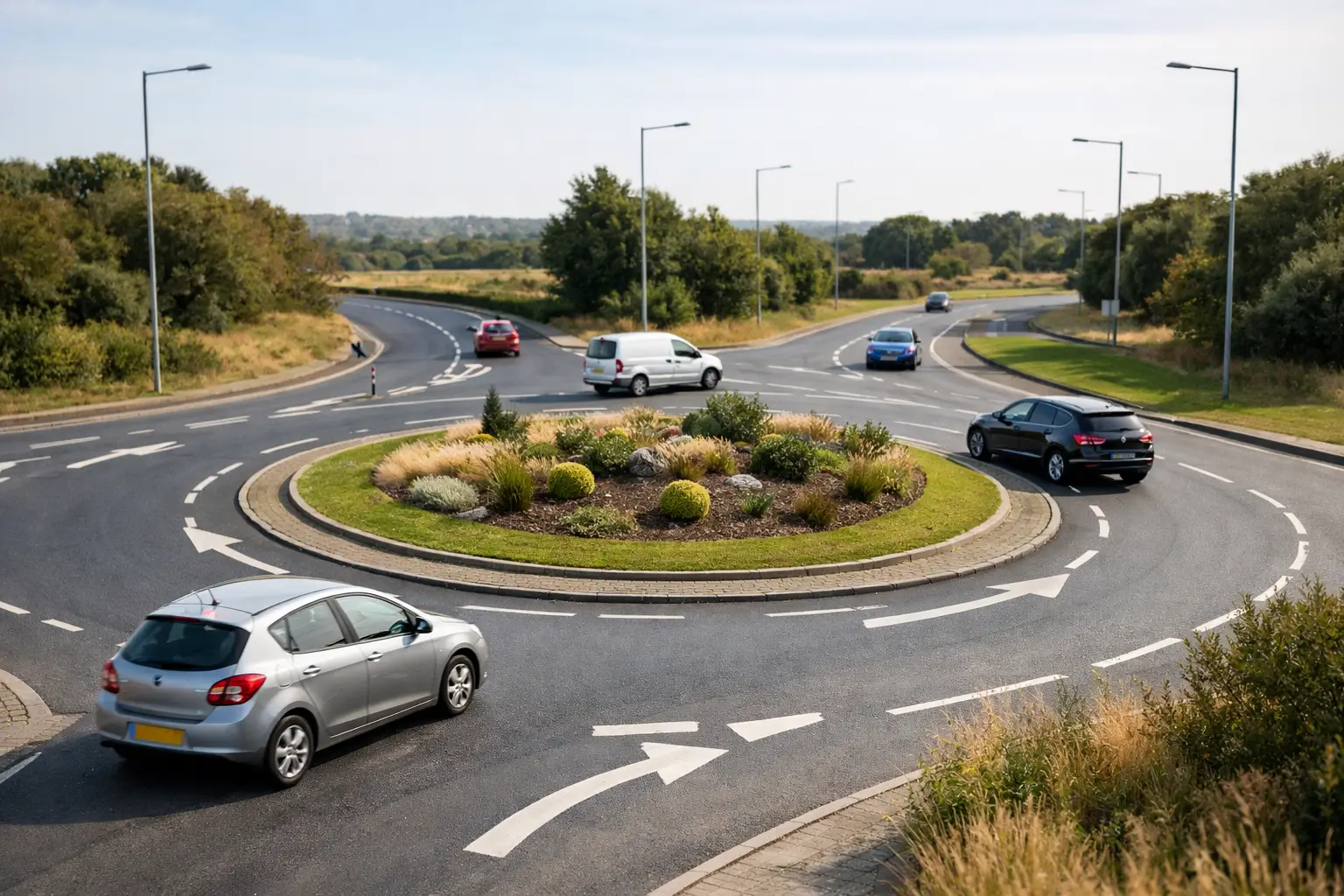
The first time a busy roundabout comes into view, it can feel as if every car on the road has suddenly agreed to test your nerves. One is signalling left but carrying on, another is flying towards the give way line, and somehow you are expected to stay calm, pick a gap and move off smoothly. If you are wondering how to gain roundabout confidence, the good news is that this is not about being naturally fearless. It is about learning what to look for, when to slow down and how to make good decisions without rushing.
Roundabouts make many learners nervous because they ask you to do several things at once. You have to read signs, choose the correct lane, watch traffic from the right, judge speed, think about your exit and keep the car under control. That sounds like a lot because it is a lot. The trick is not to become brilliant at everything in one go. The trick is to break it down until it starts to feel familiar.
Why roundabouts feel harder than they are
A roundabout often feels more chaotic than a normal junction because the decisions happen quicker. On a quiet side road, you can stop, wait and think. On a roundabout, especially a busier one, there is more pressure to read the flow and respond at the right moment. That pressure can make learners hesitate too long or, just as often, panic and go too soon.
Confidence usually improves when the situation becomes predictable. Once you understand the pattern of approach, observation, gap selection and exit, roundabouts stop feeling random. They begin to feel like a repeatable routine. Different sizes and layouts still matter, of course. A small mini-roundabout is not the same as a large spiral roundabout with road markings everywhere. But the core skills are the same.
How to gain roundabout confidence step by step
The best way to build roundabout confidence is to remove the idea that you must get it perfect straight away. You do not. You need steady practice, clear routines and enough repetition to prove to yourself that you can handle them.
Start with approach speed
Most roundabout problems begin before you even reach the give way line. If you arrive too fast, your brain has less time to process what is happening. A calm, controlled approach gives you space to think and makes the whole situation feel less intense.
Ease off early. Choose your gear in good time if you are driving a manual. Keep the car slow enough that you can observe properly without feeling hurried. Slowing down is not a sign of weakness. It is one of the main things that gives you control.
Learn to read the traffic, not just stare at it
Many nervous learners look at the roundabout but do not yet know what they are actually looking for. That is completely normal. Confidence grows when observation becomes more purposeful.
You are not simply checking whether cars exist. You are reading speed, position and signals together. Is the approaching car really leaving at the exit before yours, or is the signal misleading? Is that vehicle slowing, or does it only look slow because it is turning slightly? These are judgement skills, and like all judgement skills, they improve with practice.
A common mistake is to fixate on one car and miss the wider picture. Try to scan. Look right, assess the nearest approaching traffic, then widen your view so you can spot the next vehicle behind it. This helps you judge whether a usable gap is opening or whether it is better to wait.
Accept that not every gap is your gap
One reason roundabouts feel stressful is that learners often think they must take the first possible chance. You do not. Safe driving is not about grabbing every opportunity. It is about choosing the right one.
If a gap feels doubtful, leave it. There will be another. Hesitating for a safe reason is far better than pulling out and then realising you have misjudged someone’s speed. With experience, you will become more efficient and less hesitant. In the early stages, safety comes first.
There is a balance here. Waiting too long for a perfect gap can hold you back and increase your anxiety, because each missed chance can make the next one feel bigger. But trying to force it usually makes things worse. The answer is guided practice with an instructor who helps you understand which gaps are sensible and why.
Lane choice matters more than people think
A big part of roundabout confidence comes from knowing where you should be before you get there. If you are unsure about lane choice, the whole approach can feel rushed and messy.
Road signs and markings are your friends here. Read them early, not at the last second. In general, left lane for turning left or going ahead, right lane for turning right, but there are plenty of exceptions on larger roundabouts. That is why reading the specific signage matters more than relying on a simple rule you once heard.
If you end up in the wrong lane, do not panic and cut across. Stay calm, follow the lane you are in and let the instructor help you work out the safest next step. One wrong lane is not a disaster. Unsafe last-minute movement is the real problem.
Practise the routine until it feels boring
That may not sound glamorous, but boring is good. Confidence often arrives just after the point where something stops feeling dramatic.
A steady routine helps. Mirrors, signal if needed, position, speed, gear, observe, decide, move. At first, you will think through each part consciously. Later, much of it becomes smoother and more automatic. The goal is not to drive like a robot. The goal is to reduce the mental clutter so you can focus on the road.
The role of nerves and how to manage them
A lot of roundabout fear is not really about roundabouts. It is about the fear of making a mistake with other people watching, waiting or beeping. That pressure can rattle even sensible learners.
The first thing to remember is that other drivers do not get to dictate your safety. If someone behind seems impatient, let them be impatient. Their bad mood is not your emergency. Make your decision based on what is safe, not on whether the driver behind would like you to hurry up.
Breathing sounds like obvious advice because it is. It also works. If your shoulders are up by your ears and your hands are locked tight on the wheel, your thinking narrows. A slow breath before the roundabout, combined with a clear approach routine, can stop nerves from taking over.
It also helps to say the plan out loud while learning. Something as simple as, "Approaching slowly, checking signs, looking right, waiting for a safe gap," can keep your mind anchored on the task instead of the fear.
Why quiet practice leads to busy-road confidence
You do not build confidence by starting with the most intimidating roundabout in town and hoping for a breakthrough. You build it progressively.
Begin on quieter roundabouts where there is time to process what you see. Then move to busier ones as your judgement improves. This matters for adult learners as much as younger ones. In fact, adults sometimes put more pressure on themselves because they expect to learn quickly. Driving does not care how old you are. Confidence still comes from repetition.
In places like Peterborough, where you may encounter everything from straightforward local roundabouts to more complex multi-lane layouts, a gradual approach makes a real difference. It lets you gain skill without turning every lesson into a white-knuckle event.
Automatic or manual - does it affect confidence?
Yes, sometimes. If you are learning in a manual car, part of your attention is also on clutch control and gear choice. That can make roundabouts feel busier at first. In an automatic, there is less to manage mechanically, which can free up headspace for observation and decision-making.
Neither option is better for everyone. Some learners love the extra control of a manual once they get used to it. Others make much faster progress in an automatic because it removes one layer of stress. It depends on your learning style, confidence level and goals.
What good instruction changes
A patient instructor does more than tell you when to go. Good teaching helps you understand why a gap worked, why another one did not, and what clues to look for next time. That is where real confidence comes from.
At D4Driving, that tailored approach matters because nervous learners rarely need shouting, pressure or a one-size-fits-all method. They need calm explanations, structured practice and someone who can judge whether they need to repeat a simple roundabout again or move on to a more demanding one.
That kind of coaching also helps after a mistake. If you stall, choose the wrong lane or miss a safe gap, the lesson should not become a drama. It should become useful feedback. Learners improve fastest when they feel safe enough to make mistakes and learn from them.
A better way to measure progress
Do not judge your roundabout confidence by whether you still feel nervous. Judge it by what you can do even when you are nervous.
Can you approach at a sensible speed? Can you read the signs earlier than before? Can you spot a safe gap more reliably? Can you recover calmly if things are not perfect? That is progress. Confidence is often quieter than people expect. It is not always a big moment of feeling fearless. Very often, it is simply noticing that something which used to feel impossible now feels manageable.
The next time a roundabout appears and your stomach does that little flip, remember this: confidence is not a personality trait handed out to lucky people. It is built one calm approach, one sensible decision and one well-taught lesson at a time.