
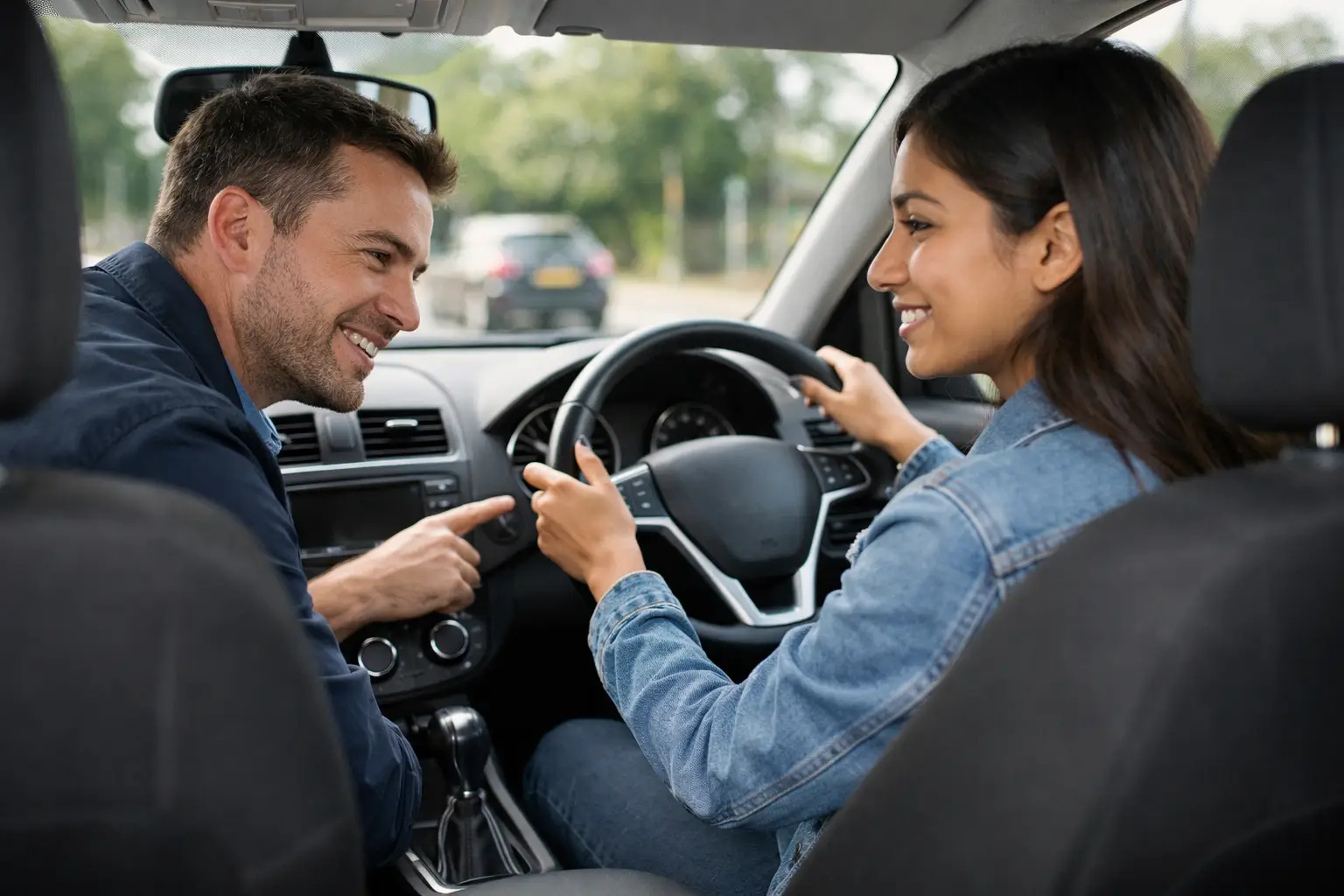
Your first driving lesson is not a surprise test where you are expected to glide through traffic perfectly while your instructor silently judges every gear change. It is a calm starting point. If you are wondering what happens during a first lesson, expect an introduction tailored to you, clear explanations and as much time as you need to settle in.
Whether you are 17 and eager to get moving, or returning to driving after years away, nerves are completely normal. A good first lesson turns those nerves into useful focus, one small step at a time.
Before you set off: getting comfortable
Your instructor will begin by getting to know you. You may be asked whether you have driven before, how confident you feel, whether you are learning in a manual or automatic car, and what you hope to achieve. There is no right answer here. Being honest about feeling nervous, having little road awareness or needing extra time with instructions helps your instructor plan the lesson around you.
You will also need to show your provisional driving licence before you drive. If you wear glasses or contact lenses for distance vision, bring them along. You must be able to read a number plate from 20 metres away, so your instructor may check this before the car moves.
Then comes the practical bit: getting settled in the driving seat. You will learn how to adjust the seat, head restraint and mirrors so you can reach the pedals comfortably and see clearly around the vehicle. This can feel like a lot of fiddling at first, but it is part of driving safely, not a delay before the ‘real’ lesson starts.
Your instructor will explain the main controls too. In a manual car, that means the clutch, brake, accelerator, gear lever, handbrake and steering. In an automatic, there is no clutch or manual gear selection to manage, which allows some learners to focus sooner on steering, observation and road position. Neither route is better for everyone. It depends on your confidence, future driving needs and the type of licence you want.
What happens during a first driving lesson on the road?
For most complete beginners, your instructor will drive you to a quiet, suitable area before you take the wheel. That might be a low-traffic residential road or another space where you can learn without the pressure of busy junctions and impatient queues behind you.
You will not be expected to pull out of a packed roundabout within ten minutes. First lessons are built around foundations. Your instructor may demonstrate an exercise, talk through it slowly, then guide you as you try it yourself. Dual controls mean they can assist with braking or the clutch when needed, so you are never left to cope alone.
The first driving task is often moving off and stopping safely. You will learn to prepare the car, check around you, move away smoothly and pull up in a safe position. In a manual, this usually includes finding the biting point and coordinating the clutch with gentle acceleration. It may take several attempts. That is exactly what practice is for.
You may also begin to steer along a quiet road, change into another gear, or learn the basic routine for pulling up on the left. Some learners progress to simple junctions in their first session; others spend the whole lesson getting comfortable with moving, stopping and steering. Both are productive lessons.
A patient instructor will give directions early and explain the reason behind them. Rather than simply saying, ‘Turn left’, they will help you spot the road ahead, choose a safe position and understand what your observations are telling you. Driving is not about memorising a script. It is about building safe habits that still work when the road looks different.
You will make mistakes, safely
Stalling, braking a little sharply, steering too late or forgetting a mirror check are all common first-lesson moments. They are not proof that you cannot drive. They are useful information: now your instructor knows what needs a clearer explanation or another go.
Try not to apologise for every mistake. Take a breath, listen to the feedback and reset. Even confident drivers once had to think carefully about where the clutch was.
How much will you drive in your first lesson?
This depends on your starting point and the lesson length you choose. A one-hour session can be a good introduction, particularly if you are anxious or have a busy schedule. A 1.5 or two-hour lesson gives more time to settle in, practise an exercise and discuss feedback without feeling rushed.
If you have previous experience, perhaps with family or friends, you may drive sooner or cover more road types. If you have never sat in the driver’s seat, the pace should be slower. Progress is not measured by how quickly you reach a particular road. It is measured by whether you are becoming safer, calmer and more in control.
At D4Driving School of Motoring, lessons are planned around the learner rather than forcing everyone through the same checklist. That matters because one person may understand the controls quickly but need time to build confidence in traffic, while another may be relaxed on the road and need more help with coordination.
What your instructor is looking for
Your first lesson is not an assessment you can fail. Still, your instructor will be observing how you respond to instructions, how you coordinate the controls and what learning style helps you most. Do you prefer a demonstration first? Do you learn best by talking through each step? Would written reminders or a simple recap after the lesson help? These details shape your future lesson plan.
They will also be looking out for safety from the beginning. That means developing good observation habits, keeping both hands under control on the steering wheel, understanding the pedals and learning to respond calmly when something does not go to plan. Confidence without safety is not the goal. Real confidence comes from knowing what to do and having practised it enough to trust yourself.
The chat at the end matters too
A useful first lesson finishes with a short review. Your instructor should explain what went well, what you practised and what will be the focus next time. You may be given something to think about between lessons, such as revising road signs, checking your eyesight or reading through the Highway Code.
This is also your opportunity to ask questions. If an instruction did not make sense, say so. If you are worried about a particular part of driving, mention it early. Good tuition is a partnership, and clear communication makes every lesson more valuable.
You may leave feeling excited, tired or slightly overloaded. Learning to drive uses your hands, feet, eyes and judgement all at once, so it is normal for your brain to feel busy afterwards. Give yourself credit for starting.
How to arrive ready for your first lesson
Wear comfortable shoes with thin, secure soles so you can feel the pedals properly. Avoid heavy boots, loose footwear or anything likely to slip off. Bring your provisional licence, your glasses if you need them, and a bottle of water if you are booked in for a longer session.
Try to arrive a few minutes early and avoid turning up on an empty stomach. Most of all, do not put pressure on yourself to be naturally brilliant. Driving is a learned skill, not a personality trait.
Your first lesson is simply the point where freedom starts to become practical. You do not need to know everything before you begin. You only need a willingness to listen, practise and take the next safe step.